 CARMEN 💜Mar 4
Animator Spotlight: Toya Oshima


- CARMEN 💜Mar 4
All gifs in order:
One-Punch Man (2015)
Dragon Dentist (2017)
Beyblade Burst God (2017)
Fate/Apocrypha (2017)
SSSS Gridman (2018) Heavy Kai Ikarashi AD
Mob Psycho Season II Episode 5 (2019)
Fate/Grand Order Absolute Demonic Front: Babylonia (2020)
Akebi’s Sailor Uniform (2022)
Ranking of Kings (2022)
Teikyo Heisei University (2022) co-ka with Moaang
Do it Yourself (2022)
Fate/strange Fake - Whispers of the Dawn (2023) Personal Presume
Jujutsu Kaisen (2023) First cut by Itsuki Tsuchigami, last cut by Takahito Sakazume
Frieren: Beyond Journey’s End (2023)
Umamusume: Pretty Derby - Beginning of a New Era (2024) AD by Ken Yamamoto
Takopii’s Original Sin (2025) ED and SB only, AD by Hayate Nakamura, KA by Shuu Sugita - CARMEN 💜Mar 4
Happy Belated Birthday Toya Oshima born February 2nd, 1994. By far one of the most unique members of the new era of action animators, Oshima is a special animator with very specific skills. Starting at Studio Khara as an inbetweener and key animator, Oshima alongside friend Gen Asano had a prolific rise. After participating in the Animator Expo working on projects of his choosing, he was quickly recruited onto anime’s top action shows under the guidance of several animators like Yoshimichi Kameda. During this period from the mid 2010s Oshima made acquaintances with Hakuyu Go a Taiwanese animator who ostensibly changed the format of fighting shonen into seasonal events,, and many others who came from Go’s cadre. After succumbing the short lived stint with Khara, Oshima moved into full time freelance work largely appearing on bigger animation heavy tv episodes. Oshima has distinguished himself being one of the few animators in Japanese animation borrowing techniques from the likes of Shinya Ohira and Shinji Hashimoto. While Oshima’s animation doesn’t contain the melting bodily motions that those two have, he emboldens their ethos through effects, background animation, and an overall dreamlike distortion to his drawings. The fruits of Oshima’s efforts came through on Fate/Grand Order Absolute Demonic Front: Babylonia where he became series action director, under the co-partnership of long time veterans Megumi Kouno and Isao Hayashi. The show was a fixed action suite, filled to the brim with the best in the game, and solidified Oshima as reliable in production management given his connections with new and exciting names in the industry. Post Babylonia Oshima’s animation has been found in small pockets on several projects, it was not until 2021 that Oshima’s acquaintance with Shunsuke Hosoi started Studio Enishiya which slowly worked its way up from commercials and music videos to a “deluxe service” of high caliber outsourced animation on tv episodes. Ex-Kyoto Animation animator Keita Nagahara has been pivotal in their success, and his relationship with Oshima came to a critical juncture in 2025’s Takopi’s Original Sin the first and certainly not last show to be produced by Enishiya. Before we get to that let’s get a play by play of Oshima’s growth as a creative.
- CARMEN 💜Mar 4
Toya Oshima’s early days are interesting, as the animator had to deal with the blitz of the Japan Animator’s Expo

This was a massive almost year spanning project (Nov 2014 - Oct 2015) coordinated by Hideaki Anno with short films made by creators at Khara and beyond. You had a wide range of directors ranging from greats like Takashi Nakamura to relative newcomers such as Isuta Meister. Oshima had been placed as a very busy in-between animator spanning an entire year of shorts. I won’t name all of them, but it is worth noting he contributed his earliest KA on a few shorts. The introductory episode of the expo (directed by the aforementioned Isuta Meister) joins a slew of young and older animators together, with Anno, Hiroyuki Imaishi, and Akira Honma as the seasoned veterans and Gen Asano, Toya Oshima, and many more as the newbies. Oshima’s cut has some gangly background animation with his signature line work already appearing. He then lends brief animation to Hidetsugu Ito’s Hammerhead and finally Girl directed by Hibiki Yoshizaki. One of the of the stranger shorts, Oshima does some beautiful flower person animation? - CARMEN 💜Mar 4
In between his time at Khara he lent his key animation as an outsourced talent on several shows with nothing remarkable until One-Punch Man where him and Gen Asano make a statement with their debut..

With mentoring from Yoshimichi Kameda we get the full extent of what these two animators are capable of. Oshima opens these with some demented morphing and running animation, shifting into a remarkable background on 1s of Genos rushing the Deep Sea King. No straight line in sight and some truly jaw dropping drawings from Oshima. Gen Asano immediately takes over with the barrage punch cuts, and Yoshimichi Kameda promptly finishing it off. This was a fantastic showcase of Oshima and Asano’s talent in a void, but even at this point they were still under Kameda’s thumb. - CARMEN 💜Mar 4
Over a year later Oshima was under the thumb of another animator/director being Hakuyu Go. Go’s debut on My Hero Academia is already incredibly well documented as the first industry assembling of the best animators in Japan and later beyond. Oshima’s scene is nothing remarkable, but it would open a wide network for him to stay busy in the coming years, where anime has become more popular than ever.
- CARMEN 💜Mar 4
Oshima made a minor acquaintance from My Hero that being effects up and comer Takumi Sunakohara who would invite him onto Three Leaves, Three Colors.

This gave Oshima an opportunity to flex his early character acting skills under Shouta Umehara and Yasuhiro Kimura’s whim. He does a brief cut of the characters getting hit with wind see his crazy smears, and the devil gag shows how he can still be expressive in a lesser scene. Worth noting that his Khara friend Shuichi Iseki was also present on this episode. - CARMEN 💜Mar 4
Perhaps a better example of Oshima flexing cute girl character acting was on Kumamiko

A somewhat forgotten anime, Kumamiko followed more acquaintances being made along the way. Oshima for the first time goes full hog on an effects and character driven ritual dance, here you can Oshima take on a slower frame rate but still actively distort the frame with his squiggly drawings, some of the animation perhaps being more akin to Yasunori Miyazawa then Shinya Ohira. The next scene with Natsu and Machi is all gags, but the final cuts of Natsu running do have an Ohira like orientation to them (especially with the morphing shadow shapes). - CARMEN 💜Mar 4
Oshima also did one cut on Episode 7 of Kiyotaka Oshiyama’s Flip Flappers. This cut would be a sign of things to come.
- CARMEN 💜Mar 4·1 reply
Opening up 2017, we get Oshima’s second and currently last work with Kazuya Tsurumaki’s The Dragon Dentist.

While waiting over the arrival of the next Evangelion Rebuild film, Tsurumaki got the chance to work with author Outarou Maijou on a new series. Presented at the Animator Expo in a short format, it was decided the story would be separated into two 46 min OVA episodes. The staff was a fairly eclectic group of individuals with many Khara regulars and outsourced staff. Yoshimichi Kameda (more so of a fan of Gainax given his past work on the Rebuilds) became the main character designer for the show, however his designs were heavily modified from the 10 minute Expo short meaning designs that looked like this now look like this. Simplification isn’t really something new for an anime, but on this scale it might have been necessary for a short form animation heavy production like this. For Oshima for the first time early in his career he was elected to the position of designer alongside Gen Asano and Korean animator Se Joon Kim serving as their senior.Early on Oshima’s role was taking up character acting scenes where one character is nearly taken by worms on one of the giant dragon’s teeth. None of Oshima’s traits are really present here, but shows he’s versatile in an emotional scene like this. The fruits of Oshima’s design works come to fruition in the second half of the OVA with the villain spiralling into madness. For the first time Oshima heavily embraces his Ohira inspiration with the strange obtuse creature designs within the belly of a creature, and you see some very confident POV shots all delivered with his squiggly macabre outlines. His creature designs are more obvious in a quicker cut later on filled with bubble, tentacle and morphing effects. While the Dragon Dentist wasn’t widely popular in the anime circuit that year it showed a more than versatile effects artist already competent enough to lead a charge, and an ability to really stand out.
- CARMEN 💜Mar 4·1 reply
Beyblade Burst God was the first show Oshima lent his hand to under the tutelage of legendary AIC director Kasuhito Akiyama

Oshima lent his hand to hyper dynamic bank shots, on Episode 8, and appeared later in the year to do an absurdly well animated morphing cut. You can see elements of Go bleed into his flare effect, but some of his liquid animation is reminiscent of Masanobu Hiraoka. - CARMEN 💜Mar 4
In the summer Oshima got the opportunity to work with Ohira on Lu Over the Wall directed by Masaaki Yuasa, it is hard to exactly know where Oshima is given the sheer presence of Ohira, but I believe this scene might be him
- CARMEN 💜Mar 4
Then later in the year we get to the big one, Fate/Apocrypha Episode 22. One of Hakuyu Go’s many sakuga slugfests, this was one of the most resplendent and widely renowned action episodes of that year given the scope and readable obtuseness of the battles taking place. Given Shun Enokido and Takahito Sakazume’s involvement as action directors this was a significant step in an episode that would shake the industry to its core.
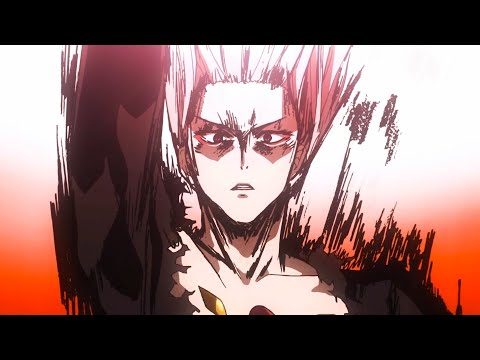
Oshima comes near the middle of the episode with the fight between Atalante and Jeanne d’Arc, a section dominated by Masami Mori and Itsuki Tsuchigami aka Miso. Oshima comes onto Mori’s section where Atalante transforms herself into a beast. More of the usual simplified morphing effects from Oshima, he does a great job of making the transformation look painful.
Later on in the Sieg vs Karna fight, Karna activates his noble phantasm in an abstract display of effects and Go’s unusual storyboarding. Oshima was not alone in his ventures on this episode, many of his friends were present but one that stood out was the oldest staff member for the episode Shinsaku Kozuma who made an acquaintance with Oshima. One of the most prestigious and unique animators mentored by the legendary Yoshinori Kanada, Kozuma appears in this section as well. Much like Ohira, Kozuma retains the post-Kanada methodology of animation, though less guided by realism. Back to back these animators make a great pair together especially when grouped with perhaps this generation’s version of Kanada, Hironori Tanaka. - CARMEN 💜Mar 4
Venturing into 2018 the year started off fairly slow with Oshima providing short OP cuts on Princess Principal and 2nd KA on Devilman Crybaby. Oshima got some minor work first on Darling in the Franxx Ep 22, and Cutie Honey Universe Episode 1, brought on by Kozuma.
- CARMEN 💜Mar 4·1 reply
Later in the year, Oshima was brought on to Episode 9 of SSSS Gridman, the directorial debut of Trigger’s best young animator Kai Ikarashi

This episode marked a turning point where much like Go’s action based spectacle, could also transcend into character based perfection. From Akira Amemiya’s mind the conceit of this episode is quite simple, where are characters are caught in an alternate reality. Ikarashi’s boards are stunning throughout and the real animation highlights come where Oshima and Ikarashi team up togethersakugabooru.com/data/e8a9cd21ea9e22f97db6d7c163f8c883.mp4). Lot’s of Ikarashi style deformation’s here, its Trigger to a T, but more distorted and warped perspectives make it ripe for Oshima’s own touches. Yuuya’s later realization takes a life of it’s own with a fantastic blitz of Imaishi-esque effects and the two animators giving some inspiring life to the Kanada style of animation
Two important acquaintances made on this episode for Oshima was China and Ken Yamamoto aka Leaf two big heavy hitters that would show up later in Oshima’s career. - CARMEN 💜Mar 4·edited
The following year Oshima would show up several times on Mob Psycho 100 Season 2

Brought on by Kameda, Oshima would appear in a number of contexts throughout the season’s run. He first appears on Episode 2 where a body hopped dimple fights against a forrest folklore spirit.
The second would be the third action opus from Hakuyu Go on Episode 5, with Mob vs Mogami.
Once again this a very loaded episode with the best of the best, although probably Go’s second most demanding episode. Many of the animators present during the city Inception tier climax have solo scenes over 23 seconds, with the busiest animators being Miso and Oshima. Oshima’s scene is a wonderful example of his flexibility as an artists, while even in a effects laden scene he’s still able to communicate a high level of emotion through Mob’s character acting. It is perhaps the apex of the episode and one of Oshima’s strongest scenes. Oshima returns later to do another character acting cut of Reigen
- CARMEN 💜Mar 4
After years of heavyweight bouts of action animation, Oshima was finally elected to an uppper echelon of battle spectacularity becoming the main action director on Fate/Grand Order Absolute Demonic Front: Bablyonia airing from mid fall 2019 to late winter 2020.

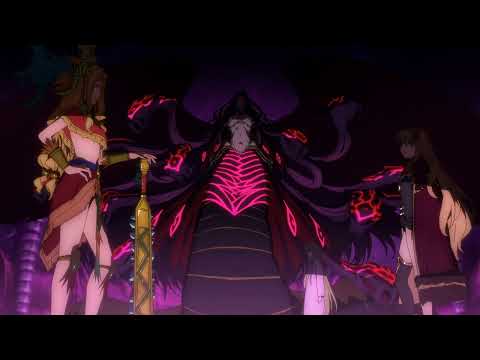
Directed by former A-1 animator Toshifumi Akai now at the newly formed sister studio CloverWorks the series was bound to be a feat of spectacle. For years the Type Moon Fate property has brought about a number of incarnations with Grand/Order being a part of many spinoffs. It is within the rights of a director to take liberties with material like this and deliver on all fronts and Akai does with a stacked cast of some of the best in-house crews. Tomoaki Takase (who worked with Oshima before on a Boogiepop PV) takes the reins of character designer with ex-Gainax animator Shouta Iwasaki as the sub. Worth noting that Takase’s corrections really holds the season together.


Prop designs were handled by the reliable Kouta Michishita. Then we get to the action direction propped up by the formidable Megumi Kouno, an ex-Doga Kobo animator so good at animation she might as well have handled the series action by herself. By her side is Isao Hayashi a long spanning 21st Century animator who’s hopped from A-1 Pictures to CloverWorks as well, one of the best auxiliary animators in the industry. And last but not least Oshima himself the young savant taken under the two veteran’s wings. - CARMEN 💜Mar 4
While the main series came out in October, a prelude Episode 0 was released early in August 2019. A mere prelude to what’s to come it combined some of the best of the main staff in a short episode, however, Kouno and Oshima were not involved, but it is worth checking out, all for some stunning KA by young animator Yusuke Kawakami
- CARMEN 💜Mar 4
Episode 1 of Babylonia, like most series openers usually sets the stage for the main frontrunners . Kouno and Oshima are of course present for the action, but this would be Oshima’s only showcase of animation for the season.
This episode wasn’t so much a large scale display of spectacle, but more so standardized the action that would be prevalent throughout the series. This would also establish a norm with Oshima bringing on certain friends from within his circle. For this episode Naoki Miyajima does a standout scene that also reveals the limitations of the show’s production, with some lacking 3d backgrounds not servicing the animation to much. However ex-Shaft animator Taiki Konno’s scene shows some fantastic background animation - CARMEN 💜Mar 4
From here on out I am only going to cover episodes where Oshima’s involvement as an action director is apparent, based on names, and certain co-action AD’s brought on board. Episode 3 has some split direction with Hayashi guiding the Gilgamesh fight, Oshima took second unit duty with Miyajima and Naoya Takahashi handling the Ishtar portions. The acrobatic cuts of the characters is incredibly impressive, especially with the complicated chain animation to boot
- CARMEN 💜Mar 4
Episode 4, and 5 has several notable names with one Shota Goshozono aka Gosso with him leading the introduction of Jaguar. Gosso’s animation is fairly hard to pin with it changing from anime to anime given his webgen, here he takes a more Kanada-esque approach likely given Oshima’s involvement. Hayashi then guides the actual fight with Eri Irei and Kosuke Kato again doing serious dynamic and weighty fight animation.

